

Your Ultimate Guide: What is SaaS accounting & what financial metrics should I use?
There has been a significant rise in SaaS businesses over the last few years, owing to the increase in the usage of cloud technology and its components – IaaS and PaaS.
Many business throughout the UK are now adopting SaaS based products over more traditional products. This is mainly due to the advances in internet connectivity and data storage. We no longer now have to store our data on expensive servers, that we don’t know how to use. The plug in and go ease of a SaaS product is exactly what the end user wants and needs – as is shown in 69% increase growth of SaaS sales in the last 5 years!
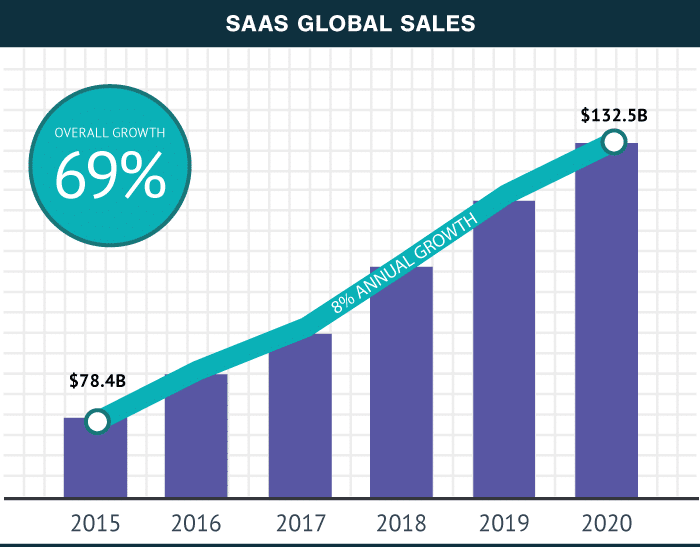
When researching this topic, here’s what we found:
As a result of the high demand from the end user, there has been a sharp incline of startup SaaS businesses who are increasing there innovations in line with their customer needs.
This has resulted in a vast amount of startups having an extremely rapid growth period.
This is when many business owners turn to accountants to help them grow their business and put financial systems in place.
Unfortunately, the mistake many of these scale up companies make is that they look for a traditional type of accountant. One with old school systems, procedures, software and resources.
Like your business, your accountant needs to be innovative, forward thinking, understanding of your business and the key metrics you need to value, to move your business forward the most efficiently and profitably.
So we have answered your question what is SaaS accounting and what metrics should I be using?
What is SaaS accounting?
SaaS business provide their customers with a subscription based product and service. This caused a somewhat disconnect between the general accepted accounting principles (GAAP) and the new SaaS based company.
A more traditional software company for example could sell a product for £120 to 500 customers and they would have a instant revenue of £60,000. This is not the case with a subscription based SaaS company.
Accounting for SaaS companies has to be different and we account for a difference in revenue recognition.
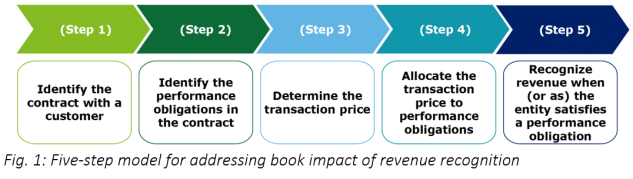
There are two types licensing models subscription or perpetual (things like set up fees). So it’s important to distinguish between the two when accounting for this.
With the shift in traditional software to a SaaS model, the success of the business does not depend on how many software’s are sold, but instead on how many customers are willing to use your product on a recurring basis.
Which brings me on to the first key financial metric you should be using to maximise your profits;
Monthly recurring revenue (MRR)

You will more likely be operating a subscription based service to your customer and therefore, this will be your first key metric to analyse before you set on your journey to increase your business profitability.
Recurring revenue is the stream of revenue that continues to flow into your business, similarly, monthly recurring revenue is the amount of money your customers will continue to send to your business on a monthly basis.
There are few categories within MRR:
- NEW MRR – all new monthly revenues
- Expansion MRR – all existing customers who have moved to a bigger package therefore increasing their revenue
- Reduction MRR – all existing customers who have moved to a smaller package therefore reducing their revenue
- Churn MRR – customer revenue that has expired
How to calculate MRR
Estimating MRR is pretty easy as you just have to remove one-off sales (like set up costs) from the total monthly revenue.
Or you can also calculate MRR by multiplying the subscription cost by the number of subscribers.
Here’s the formula:
MRR= (new MRR + expansion MRR) – (reduction MRR+ churn MRR)
It is very important to note that the number of subscriptions alone will never provide you with the relevant information required to evaluate the financial state of your business but it is the amount of revenue that is reappearing into your business bank account.
Customer Churn Rate (CCR)
Customer churn rate (CCR) describes how many renewable customers you lose within a time frame. For SaaS subscription businesses this is on a monthly basis. A certain amount of churn is inevitable, but it is in your best interest to have the churn rate as little as possible.
Firstly, we must look at what causes customer churn.

Apart from the inevitable, like customers going out of business or those with cash flow problems, other factors affecting the CCR is something we can look at and improve on. Here are some factors to consider:
- Bad onboarding
- Bad support
- Competitor-driven churn
- You closed on the wrong type of deal
- Product problems
So once these issues have been ironed out, we should have happy and loyal customer base with a low customer churn rate! Another benefit to nurturing existing customers is there ability to endlessly give you free marketing through endorsements to peers and other businesses.
How to calculate Customer Churn Rate
- You need to choose a time frame. For a SaaS business thie will usually be 30 days
- Divide the total number of customers LOST by the total number of customers at the BEGINNING of the set time period.
- Express the result as a percentage.
The formula:
CCR = (total clients at the beginning – total clients at the end) / total clients at the beginning
For Example:
Aiaccounts.com has 50 clients at the beginning of the month and at the end it has 48. What is the churn rate?
(50- 48)/50 = 0.04
CCR = 4%
A good way of measuring customer satisfaction is through monitoring your NPS score
Revenue Churn Rate (RCR)
While we’re looking at churn rates we wouldn’t want to overlook revenue churn rate as well!
Revenue churn is the a measure of lost revenue. It can be eye opening, particularly so if you offer a tiered subscription service, like most SaaS businesses do. This is because customers can go in and change the type of service level they require, thus impacting the revenue and profitability.
Therefore, there can be substantial difference between the customer churn rate and the revenue churn rate. So it’s advisable to measure both closely, especially as you scale as you don’t want any nasty surprises later on along the journey.

How to calculate Revenue Churn Rate
- Divide your monthly recurring revenue (MRR) at the BEGINNING of the month by the MRR LOST that month less and NEW revenue
- express that result as a percentage
Formula as follows:
RCR = ((Beginning MRR – End MRR) – MRR gained) / beginning MRR
For example:
Aiaccounts.com has a beginning MRR of £10,000 and an MRR at the end of the month of £8,500, it did also gain an additional £1,000 from upgrades and addons.
The calculation would be as follows:
((10,000-8,500)-1,000 )/ 10,000 = 0.05
RCR = 5%
You want to always strive for a negative RCR – this means you’re making money!
The average revenue per customer (ARPA)
The average revenue per customer metric if a good way to assess the scope of your deal size before you work towards increasing it, by increasing the deal size and not the number of customers. Why work so hard and dedicate a tremendous amount of resources to broaden your customer base, when you can simply start pocketing further profits from your existing customers by up-selling.
As a SaaS business you are already doing a great job of up-selling due to the differing tiered packages on offer.
Two great ways to increase your revenue with customers are:
- Offer up-sells on your shopping basket. Show your customer the best selling packages – they’re just about to purchase, so now is the best time to get that little bit more revenue.
- Offer pay yearly plans as well as a monthly option. This can keep people in your system, ensures revenue and less churn!
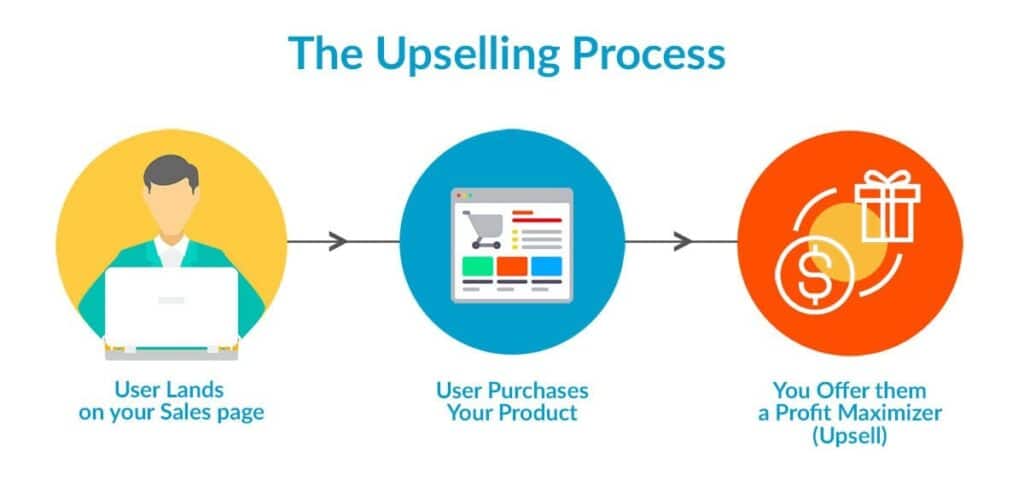
Although this isn’t strictly just a SaaS metric, it’s always a good one to have in the arsenal. It is always cheaper to upsell to an existing customer than to hunt for new one!
A good 5 minute blog to read would be a post from Alex Siminoff on the Art of Upselling
Customer Acquisition Cost (CAC)
‘V’
Customer Lifetime Value (LTV)
You need to keep in mind that the number of subscriptions alone would be insufficient to track your business’s financial position and standing in the market. There are other metrics to consider when it comes to investigating the financial health of a SAAS business, things such as the cost being incurred to acquire a new customer and how much value can you extract from that customer.
Customer Acquisition Cost and Customer Lifetime Value are the two metrics that hold significant relevance when checking the financial health of a SAAS business.
Customer Acquisition Cost is the cost incurred by the company to acquire a specific customer, whilst Customer Lifetime Value represents the amount of monetary value a firm can derive from a customer through its lifecycle.
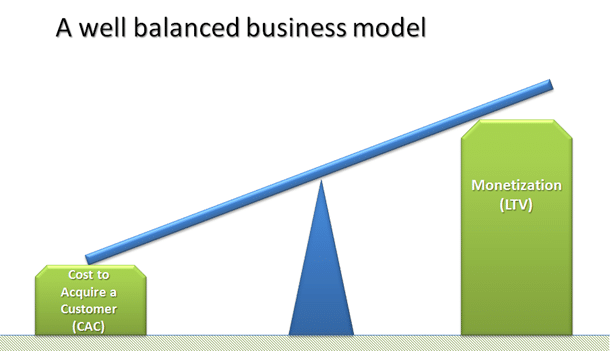
It is important to ensure that the cost of acquiring a customer should not exceed the amount of value a business can derive from that customer, in other words, your CAC should never exceed your LTV or otherwise, you are losing more value than what you are generating.

A well balanced business model requires that CAC is significantly less than LTV:
You should ensure that you encourage your managers to employ effective marketing strategies like ‘customer retention strategies’ to avoid wasting your resources and capture the interest of the customer with minimal effort. Speak to your accountant when building a management reporting process, ask them to measure the SAAS metrics on top of the other financial measures to help you estimate the actual performance of the business.
For a more indepth look into the cost of aquistion we’d recommend reading a blog by Daviv Skok called “Startup Killer: the Cost off Customer Acquisition”
Cash flow
A survey revealed that there is a considerable proportion of businesses that fail because of the lack of control of their cash flow. Whilst many pay attention to their profits and cash receivables, only a few give due importance to their cash flow.
Imagine running out of cash to manage the daily activities of your business, paying out salaries, paying electricity and gas bills etc, even if you have payments due from your customers.

Maintaining control over the cash flow becomes really complicated and risky for SaaS businesses as they have to ensure that their customers are paying for their subscription on a regular basis.
With customers not paying for the subscriptions on time, SaaS businesses can end up in trouble in multiple ways, for instance, they do not receive the cash for the service they have already provided, forcing them to cover the costs required to provide the subscription services without any cash in hand.
To be effective in your strategies, study more about what cash flow really is and how it can significantly impact the operations of your business.
Once you think you have gained enough knowledge about managing your business’s cash flow, enlighten your managers about different ways they can ensure steady, efficient and maximum cash flow.
Alternatively hire a good Accounting Firm who have the right in-house trained accountants that can help you build cash flow forecasts, cash burn reports and effective credit control systems like this:

Either way, you need to keep in mind that your cash flow is one of the primary and decisive factors that is going to play a critical role in the survival of your SaaS business.
The Take Away
It’s all about taking the right decision at the right moment. Play your cards at the wrong time and your cash flow can reduce significantly which in result can negatively impact the overall survival of your business.
Hence, it is wise to keep track of a few metrics that are extremely relevant to the performance of your SaaS business. Keeping track of such metrics will always leave room for the business to improve its profitability and sustainability.
These metrics are just the tip of the iceberg. If you are preparing your business for potential investors or are looking for a series funding round, it is advisable to hire a specialist SaaS Accountant; who should be able to help you design effective SaaS reporting processes using the correct metrics enabling you to present a good picture to potential investors.
AI Accounts are specialist SaaS accounting! We have years of experience working with highly innovative SaaS businesses in the UK, helping them prepare effective SaaS management information on top of their compliance and statutory obligations.
Recent Blogs

The VAT in your bank account was never yours
One sixth of every VAT-inclusive invoice belongs to HMRC from the day it lands. What to set aside, when it falls due, and what paying late costs.

Your gross margin has changed. Your accounts probably do not show it.
Usage based AI costs behave like cost of sales, not overheads. Where they land decides whether your gross margin is telling you the truth.
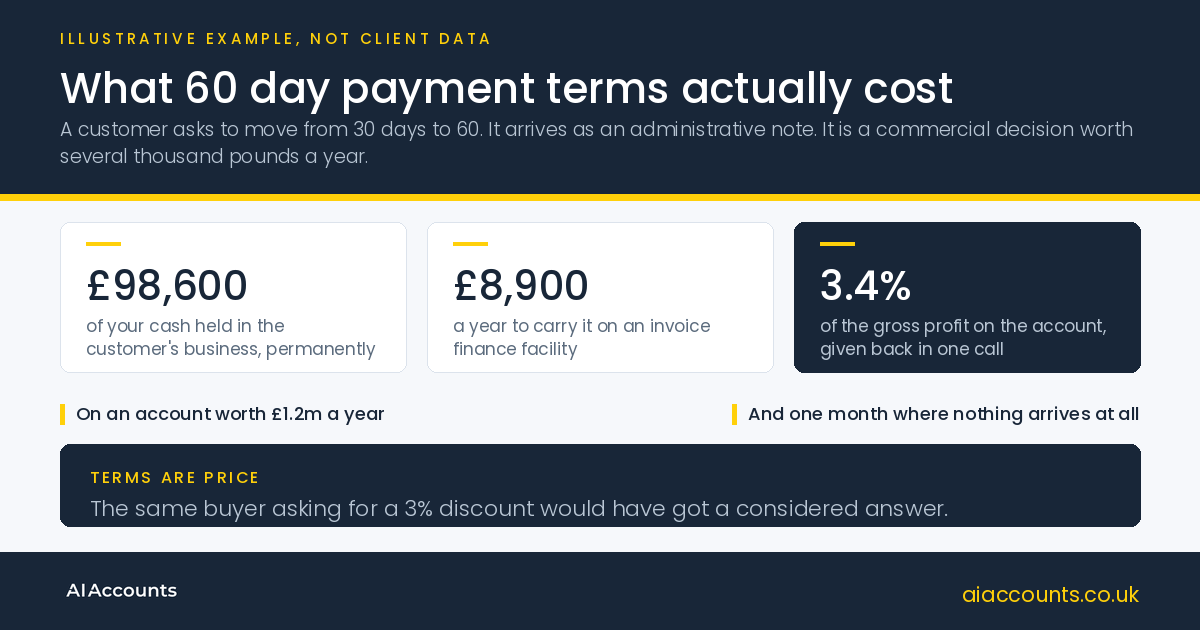
What 60 day payment terms actually cost
A customer asks to move from 30 to 60 days. Here is the arithmetic on what that costs you, and four answers worth giving in order.

Profit is not the same as what you can afford
£214,000 of profit and £31,000 in the bank. Where the difference sits in an owner-managed business, and how to work out your own figure this week.
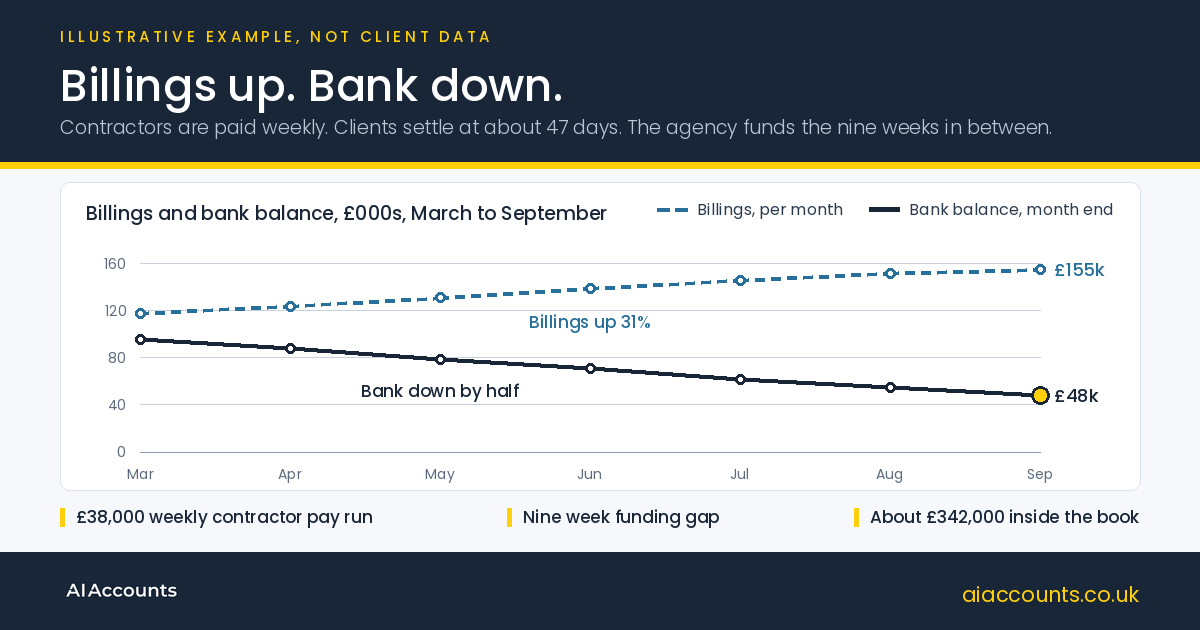
Why a record billing month can leave a recruitment agency short of cash
Billings up, bank down. Why a contract desk funds nine weeks of contractor pay before clients settle, and how to work out your own figure.
Profit is not cash: why profitable businesses run short of money, and how to see it coming
Profit is a record of the past, the bank balance is a photograph of one morning, and neither answers what you can afford. Where the money sits, why good months bite, and the one page that shows it coming.

Financial controller vs outsourced finance function: which does your business need?
A financial controller costs more than the salary suggests, and buys one level of skill. An outsourced finance function buys several. Here is how the two compare on cost, cover and strategic input, and when each one is the right call.

Why profitable software businesses still run out of cash
A software business can be growing, profitable and still run out of cash. Why revenue and cash pull apart in software, and the one report that fixes it.
Management accounts that actually help you decide
Most management packs are built to look thorough, not to be used. What good management accounts do differently, and the test to apply to yours.

Budgeting and forecasting: how owner-managed businesses stay ahead of cash
A budget is a plan. A forecast is your early warning system. How owner-managed businesses use both to see cash coming, test decisions before committing, and avoid being caught short.


